Think about how children behave when they encounter something new. Do they sit quietly and listen to explanations for hours? Not really.
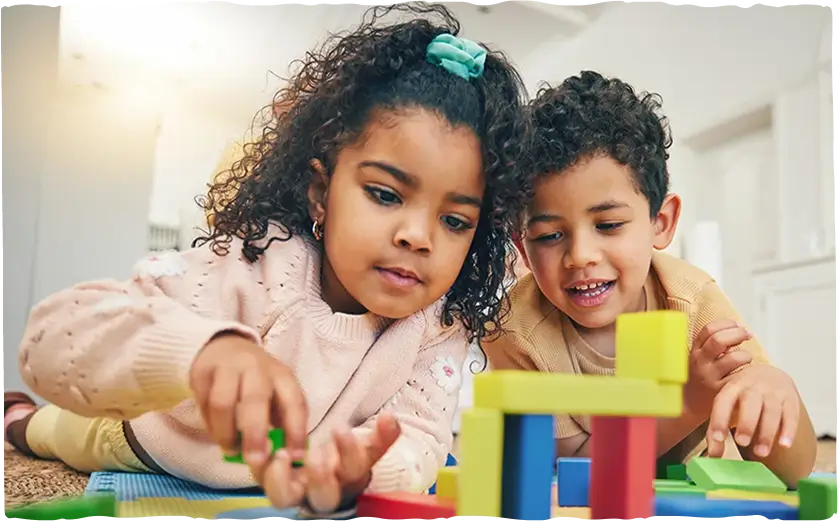
A toddler stacking blocks might knock them down again and again. Why? Because they are discovering balance, gravity, and spatial relationships without even realizing it.
This natural curiosity is exactly what play based learning builds upon. Instead of separating learning from play, educators integrate them. Activities are designed so children absorb important skills while they are actively engaged.
For example, imagine a classroom where children run a pretend grocery store. One child acts as the shopkeeper. Another becomes the customer. They count toy fruits, exchange pretend money, and organize items on shelves.
In this simple activity, children practice:
And they do all of this while enjoying themselves. Isn’t that a much more memorable learning experience than simply memorizing numbers from a worksheet?
Children learn best when they actively interact with their environment. When they build, explore, or role-play, their brains process multiple types of information simultaneously.
Consider a group of children building a bridge using wooden blocks. At first, the bridge collapses. What do they do next? They adjust the structure, add more support blocks, or change the design. Without formal instruction, they are experimenting with engineering principles.
This trial-and-error process strengthens critical thinking. It also teaches persistence. Instead of fearing mistakes, children begin to see them as part of learning.
That is why many early childhood educators rely on play based learning to strengthen cognitive development in meaningful ways.
Learning in early childhood is not just about numbers and letters. Social and emotional skills are equally important. Think about a simple playground game where children pretend to be explorers searching for treasure. One child becomes the leader, another holds the map, and others search for clues.
Through this activity, children practice:
Have you noticed how much children talk while playing? They describe what they are doing, explain their ideas and even invent stories. For example, during pretend play, a child might say: “This is my hospital. The teddy bear is sick, and I need to give medicine.”
In that moment, the child is expanding vocabulary, building sentence structure, and practicing storytelling.
Teachers often support this process by asking open-ended questions:
These questions encourage children to think deeper and express their thoughts more clearly. Over time, this interactive environment strengthens language development far more effectively than passive learning methods.
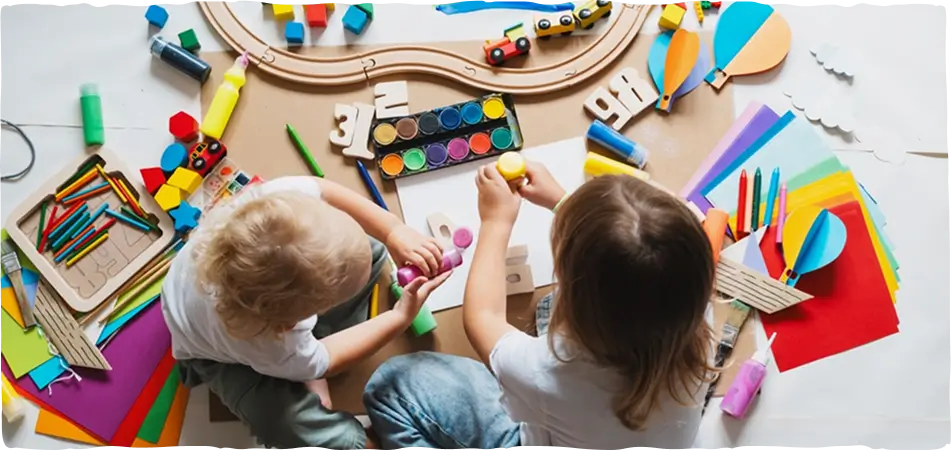
Children have an incredible ability to turn ordinary objects into something extraordinary.
At the same time, teachers might introduce small learning elements. For example, children might count each jump or follow directional instructions. This combination of movement and thinking strengthens both the body and the brain.
When children control their own play activities, they feel a sense of ownership over their learning. Instead of waiting for instructions, they make decisions:
Play does not mean lack of structure. In fact, effective learning environments carefully design play activities that support development. Teachers observe how children interact with materials and guide them with thoughtful questions.