
Montessori Learning Activities for Early Childhood Development: 15 Practical Ways to Build Essential Skills
Early childhood education in India is gradually moving beyond textbook-based learning towards experiences that help children become more independent.
This approach connects closely with the Montessori philosophy, which encourages children to develop skills through hands-on experiences, independent exploration and purposeful activities. Instead of simply telling a child how something works, Montessori learning gives them the opportunity to discover it themselves.
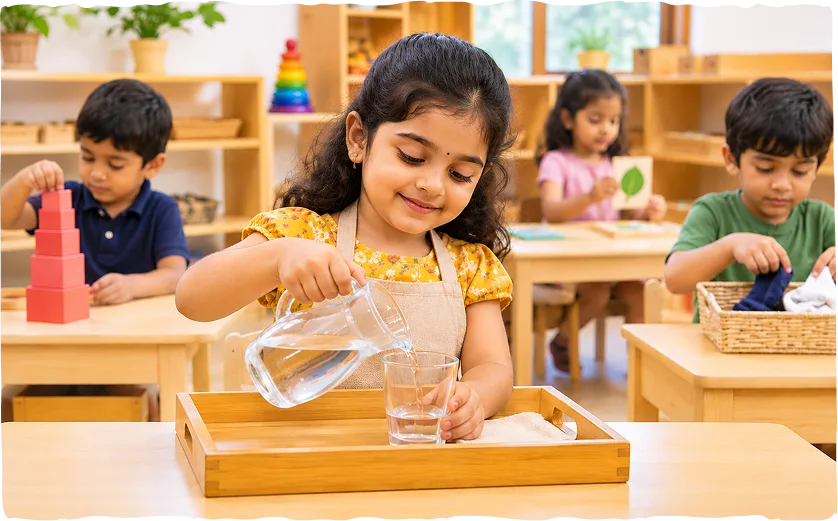
Think about a three-year-old pouring water into a glass, sorting colourful blocks, matching socks or helping organise toys after playtime. These activities may appear simple, but they encourage children to practise coordination, concentration, communication, problem-solving and decision-making.
The real value of Montessori learning activities is not simply keeping children occupied; it is helping them develop skills they can use independently in everyday life.
For parents, preschool educators and early childhood care providers, understanding which activities support different developmental areas can make everyday learning more meaningful. Let’s explore 15 practical Montessori activities for preschoolers, their developmental benefits and how to introduce them at home or in a preschool environment.
What Are Montessori Learning Activities?
Montessori learning activities are hands-on tasks that encourage children to understand concepts through exploration, repetition and practical experience. They are based on the educational philosophy developed by Maria Montessori, which emphasises independence, curiosity and learning at an individual pace.
Unlike activities that focus primarily on completing worksheets or memorising information, Montessori activities allow children to interact with materials, make choices and learn through direct experiences.
For example, when a child sorts buttons by colour, they are not simply playing with objects. They are practising observation, classification, visual recognition and early mathematical thinking.
Montessori learning generally covers five important developmental areas:
- Practical life: Everyday tasks such as pouring, cleaning, folding and arranging objects.
- Sensorial development: Exploring textures, sounds, shapes, colours and sizes.
- Language development: Building vocabulary, recognising letters and developing communication skills.
- Mathematical understanding: Counting, sorting, matching and recognising numerical patterns.
- Cultural and environmental learning: Understanding nature, animals, geography and the world around them.
The objective is to connect learning with experiences children can understand, practise and repeat in their everyday surroundings.
15 Montessori Learning Activities for Early Childhood Development
The following activities are suitable starting points for children between two and six years, depending on their individual abilities. Most use everyday materials, making them practical for both home and preschool environments.
1. Pouring Water Between Two Containers
Give your child two small, lightweight containers and a little water. Demonstrate how to hold one container and slowly pour water into the other.
Initially, children may spill water or struggle to control the movement. Allow them to practise rather than immediately correcting every mistake.
This activity improves hand-eye coordination, strengthens fine motor control and develops concentration. It also introduces children to basic concepts of quantity and careful movement.
2. Sorting Objects by Colour and Shape
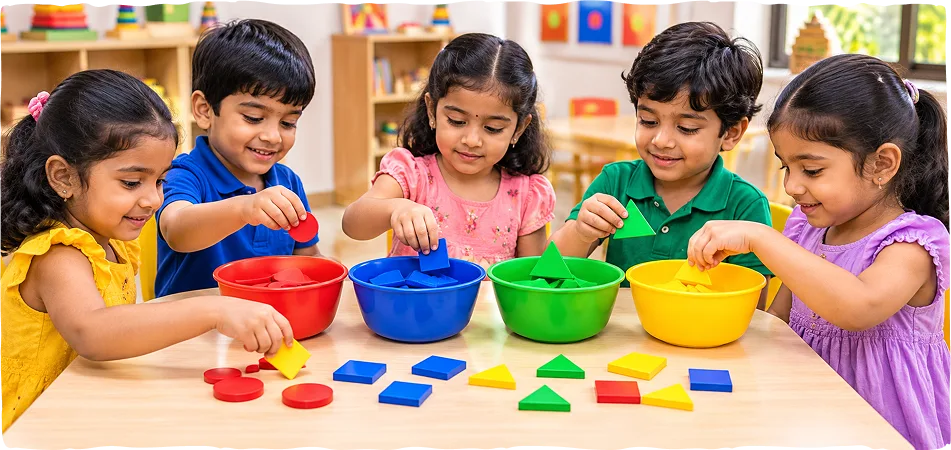
Collect large, child-safe objects in different colours and shapes. Place a few bowls on a table and ask your child to put similar objects together.
For example, red objects go into one bowl, blue objects into another and yellow objects into a third. Once the child understands the activity, introduce additional sorting rules, such as grouping objects by shape or size.
This activity develops visual discrimination, classification skills, early mathematical thinking and attention to detail.
3. Transferring Objects Using a Spoon
Place two bowls on a tray and fill one with large, age-appropriate objects. Give your child a suitable spoon or transfer tool and demonstrate how to move the objects from one bowl to another.
The challenge is to transfer each object carefully without dropping it. This activity strengthens finger and wrist movements, develops coordination and encourages children to complete a task independently.
4. Matching Everyday Objects
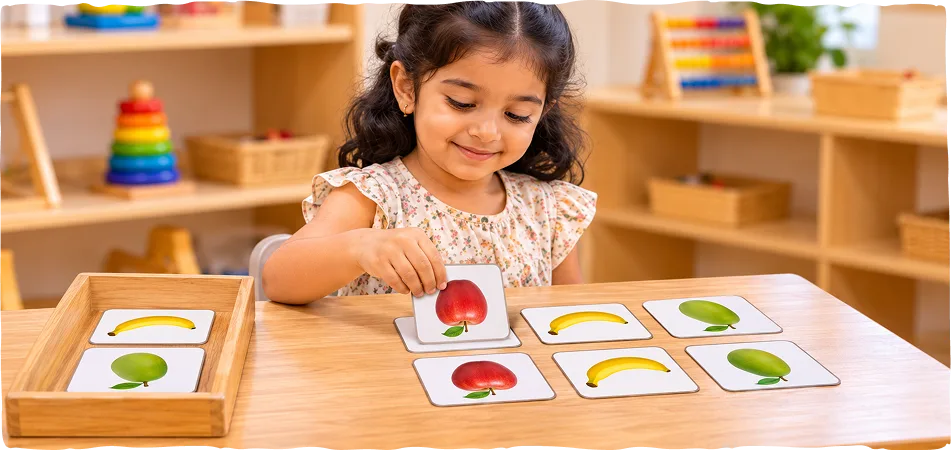
Choose familiar objects such as socks, cups, spoons or picture cards. Place matching pairs separately and encourage your child to identify which objects belong together.
You can gradually introduce more challenging combinations, such as matching an animal picture with its name or a household object with its use. Matching activities improve memory, observation, logical thinking and visual recognition.
5. Washing Fruits and Vegetables
Give your child a small bowl of water, a few washable fruits and a child-safe brush. Show them how to gently wash each fruit and place it in a separate container. Talk about the colours, textures and names of the fruits while completing the activity.
Besides encouraging personal responsibility, this activity introduces children to basic hygiene, sensory exploration and everyday vocabulary. Always supervise children around water and ensure they use age-appropriate materials.
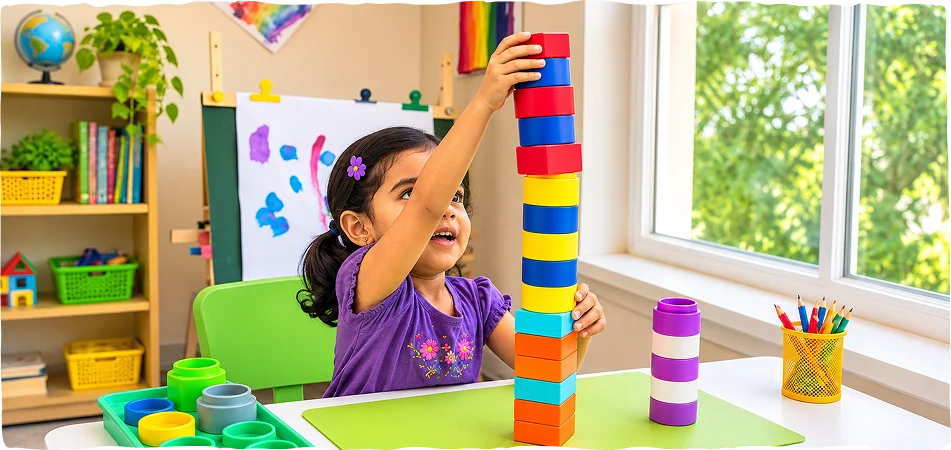
6. Building Towers with Blocks
Provide wooden or soft building blocks and encourage your child to create a tower, bridge or simple structure.
Instead of showing them exactly what to build, let them experiment with different arrangements. Ask questions such as, “What happens if we put the bigger block at the bottom?”
Building activities develop spatial awareness, balance, problem-solving, creativity and an early understanding of size and structure.
7. Practising Letter Recognition with Sand
Spread a thin layer of clean sand in a shallow tray. Demonstrate how to trace a simple letter using one finger.
Start with letters familiar to the child, such as the first letter of their name. Encourage them to repeat the movement and say the letter aloud.
This tactile activity supports letter recognition, pre-writing skills and coordination between hand movements and visual observation.
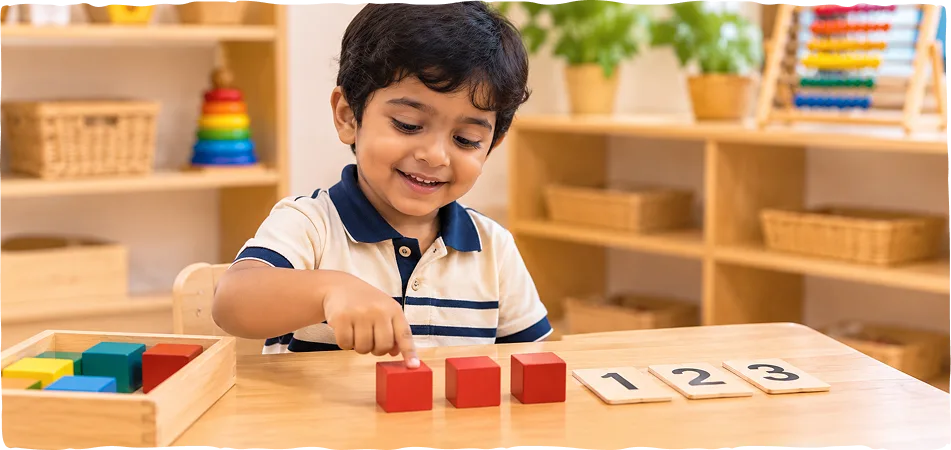
8. Counting Everyday Objects
Use large blocks, toy animals or other safe objects to introduce counting. Place three objects in front of your child and count them together, touching each object once.
Gradually increase the number as the child becomes comfortable. The important distinction is helping children understand that each number represents a quantity rather than simply memorising number names.
This activity develops number recognition, one-to-one correspondence, counting ability and early mathematical understanding.
9. Buttoning and Unbuttoning Clothes
Give your child a large-button fabric frame or an old garment with large, secure buttons. Demonstrate how to hold the fabric, push a button through its opening and pull it out.
Allow them to repeat the process at their own pace. This activity improves finger strength, bilateral coordination, hand control and independence in dressing.
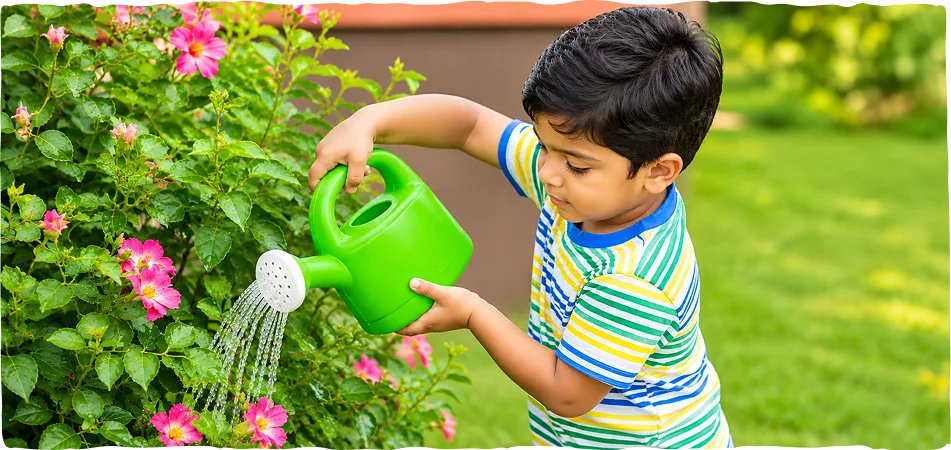
10. Watering Plants
Give your child a small watering can and allow them to water a plant using a manageable amount of water. Explain that plants need water and sunlight to grow.
You can also encourage them to observe changes in the plant over several days. Watering plants develops responsibility, observation, environmental awareness and an early understanding of nature.
11. Creating Patterns with Beads
Using large, age-appropriate threading beads, demonstrate a simple pattern such as red-blue-red-blue. Ask your child to continue the sequence.
Once they understand basic repetition, introduce more complex patterns. This activity develops sequencing, logical reasoning, pattern recognition and fine motor coordination. Avoid small beads and use only age-appropriate materials under direct supervision.
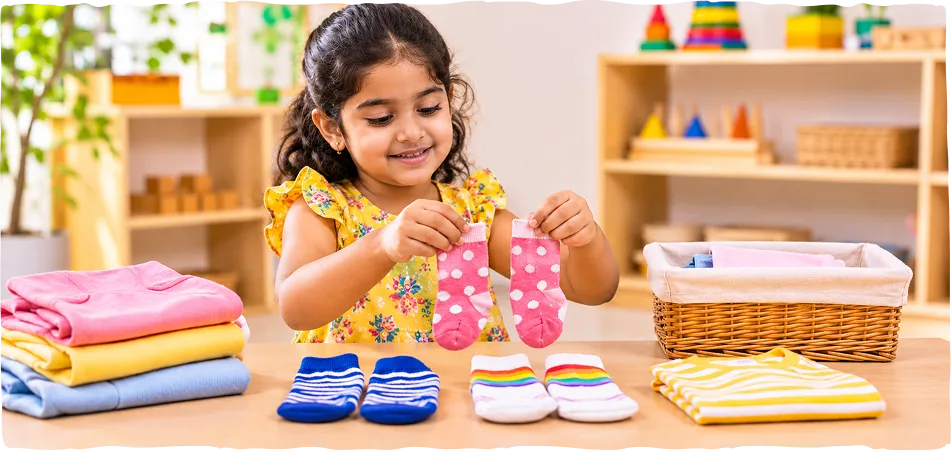
12. Folding Clothes and Matching Socks
Give your child a few clean, lightweight clothes or pairs of socks. Demonstrate how to fold a small cloth and match socks based on their colour or design.
Allow them to organise the finished items in a basket. This simple household activity strengthens organisation skills, visual matching, coordination and independence in everyday routines.
13. Identifying Sounds Around the House
Ask your child to close their eyes while you make familiar sounds, such as gently tapping a spoon against a bowl or shaking a container. Ask them to identify what they heard.
You can also take a short listening walk and identify birds, footsteps, vehicles and other everyday sounds. This activity improves auditory discrimination, listening skills, attention and vocabulary.
14. Creating a Simple Picture Story
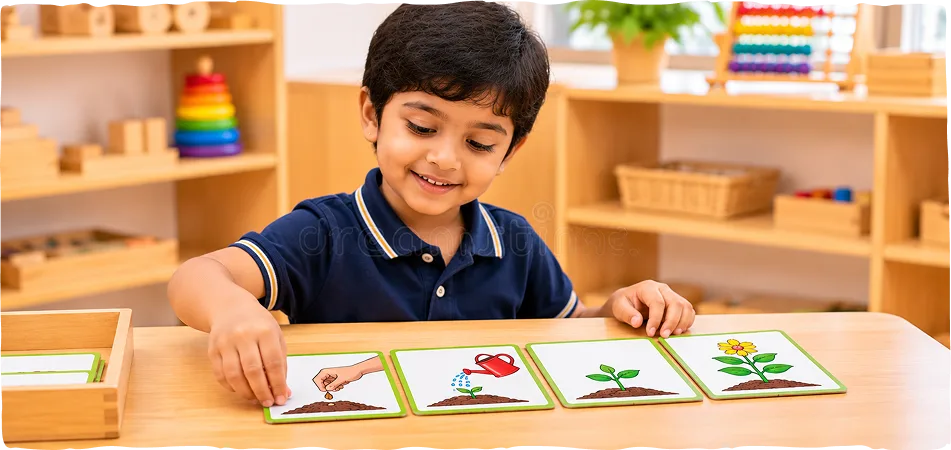
Give your child three or four picture cards showing a simple sequence, such as planting a seed, watering it and watching it grow. Ask them to arrange the pictures in order and explain what is happening.
There is no need to expect a perfect explanation. Encourage them to describe what they see using their own words. This activity builds vocabulary, sequencing, imagination, comprehension and communication skills.
15. Cleaning and Organising a Small Area
Give your child a small cloth and ask them to wipe a child-safe table or arrange toys on a low shelf. Demonstrate the task first and show them where each item belongs. Keep the activity manageable rather than turning it into a long cleaning routine.
Cleaning and organising encourage responsibility, independence, concentration, coordination and an understanding of everyday routines.
How Do Montessori Activities Support Different Areas of Child Development?
A useful way to choose activities is to understand which developmental skills they practise. One activity can support several areas simultaneously, but its primary learning objective should remain clear.
| Developmental area | Skills children develop | Example activity |
|---|---|---|
| Cognitive development | Memory, reasoning and problem-solving | Sorting and matching |
| Physical development | Balance, coordination and motor control | Pouring and transferring |
| Language development | Vocabulary and communication | Picture storytelling |
| Social-emotional development | Patience, confidence and responsibility | Cleaning and organising |
| Mathematical development | Counting and recognising patterns | Counting blocks and bead patterns |
These skills are particularly relevant during the preschool years, when children are developing the foundations for more complex learning.
How Can Parents Introduce Montessori Activities at Home?
You do not need a fully equipped Montessori classroom to encourage independent learning. Everyday household objects can become useful learning materials when children have a safe environment and appropriate guidance.
Here are four practical ways to get started:
- Create an accessible learning space: Keep a few age-appropriate toys, books, baskets and activity materials on low shelves so children can choose and return them independently.
- Demonstrate before explaining: Show your child how to complete an activity through slow, simple movements. Give them time to practise afterwards.
- Allow repetition: Children often repeat the same activity because they are still developing control and understanding. Avoid interrupting unnecessarily.
- Choose activities based on ability: Introduce simple tasks first and gradually increase their difficulty as the child becomes more confident.
Most importantly, do not turn every activity into a test. The purpose is to encourage exploration, not measure how quickly a child can complete a task.
Conclusion
Early childhood development involves much more than recognising letters, counting numbers or completing worksheets. Children also need opportunities to develop independence, communication, coordination, concentration and problem-solving skills.
That is where Montessori learning activities offer practical value. From pouring water and folding clothes to identifying sounds and creating picture stories, simple experiences can become meaningful learning opportunities when introduced with the right guidance.
For parents, the starting point can be as simple as giving children a small responsibility at home. For preschool educators, thoughtfully planned activities can help create an environment where children learn through participation rather than passive instruction.
Want to give your child a more engaging and meaningful early learning experience? Contact Bodhi Montessori and discover how purposeful, hands-on learning can support your child’s development. Get in touch with our team to learn more!
Frequently Asked Questions

What are the best Montessori activities for preschoolers?
Pouring water, sorting objects, matching shapes, counting blocks, folding clothes and watering plants are practical activities for developing essential preschool skills.
At what age can children start Montessori activities?
Simple sensory and practical activities can begin during toddlerhood. Their complexity should increase gradually according to the child’s age, interests and developmental abilities.
Do Montessori activities improve concentration?
Activities involving repetition, sorting, transferring and sequencing give children opportunities to practise attention and concentration. Individual results will vary.
Can Montessori activities be done at home?
Yes. Parents can introduce Montessori-inspired activities using everyday materials such as cups, bowls, clothes, blocks, picture cards and household objects.
How are Montessori activities different from traditional preschool activities?
Montessori activities generally emphasise hands-on exploration, individual choice, practical skills and learning at an individual pace, rather than relying primarily on teacher-led instruction and memorisation.