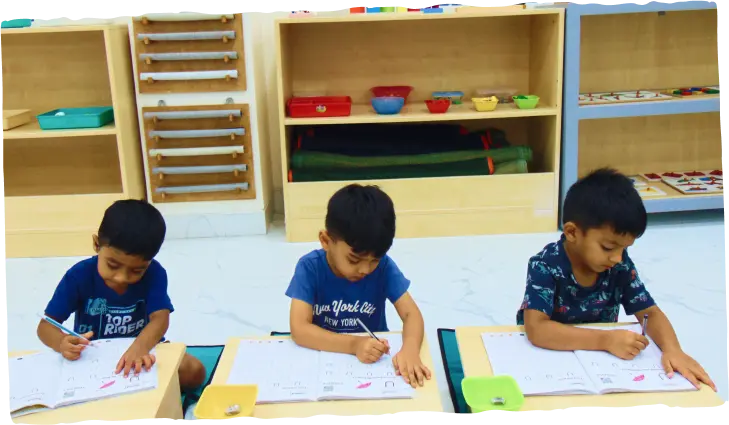

How the Montessori Method Helps Children Become Independent Learners
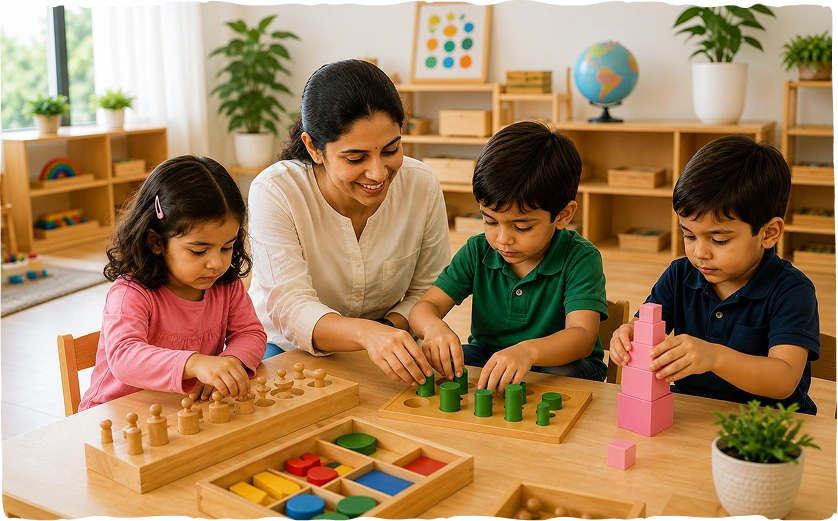
“What if your child didn’t always wait for an adult to tell them what to do, but instead felt confident enough to ask, explore, try, make mistakes, and try again?”
That is one of the most important questions we can ask when thinking about early childhood education. After all, learning is not only about remembering letters, numbers, colors or facts. It is also about developing the confidence to think independently and take responsibility for the learning process.
There is encouraging evidence behind this idea. A systematic review of 32 rigorous Montessori studies involving more than 132,000 data points found positive effects not only on academic outcomes but also on non-academic areas. At Bodhi Montessori, we believe learning is not simply about teaching children what to think. It is about helping them discover how to learn, explore and solve problems with confidence.
Through the Montessori method, children get opportunities to make choices, work with their hands, practice real-life skills and learn at their own pace. Over time, these everyday experiences help transform curiosity into independence.
What Makes the Montessori Method Different?
Traditional learning can sometimes place the adult at the center. The teacher explains, the child listens, and everyone moves through activities at roughly the same pace.
Montessori takes a different approach. The child is an active participant in the learning process. The classroom is carefully prepared with age-appropriate materials that invite children to explore. Teachers observe, guide and introduce activities when needed rather than constantly directing every action.
This does not mean children are simply left to do whatever they want. Montessori learning combines freedom with structure. Children learn how to choose meaningful activities, use materials appropriately, complete tasks and return them to their places.
That balance is important because independence does not develop from unlimited freedom. It develops when children have the right opportunities, clear expectations and enough time to practice.
At Bodhi Montessori, this philosophy forms an important part of our approach to holistic development. Our integrated Montessori programme supports sensory and perceptual development, gross and fine motor skills, self-care, cognitive growth, social development and emotional development.
Independence Begins With Small Everyday Choices
For adults, choosing an activity or putting something away may seem insignificant. For a young child, these actions can be meaningful milestones. Imagine a four-year-old entering the classroom. Instead of waiting for an adult to tell them what to do, the child looks around, selects a familiar Montessori material, and begins working.
Perhaps they choose a practical-life activity involving transferring objects from one container to another. They carry the material carefully, arrange it, complete the activity, and return everything to its place.
There may be no worksheet or loud instruction involved, and yet the child is learning several things at once:
- How to make an appropriate choice
- How to begin a task independently
- How to concentrate
- How to handle materials carefully
- How to complete what they started
- How to take responsibility for their surroundings
These small experiences gradually build habits that extend far beyond the classroom.
How Montessori Helps Children Become Independent Learners
1. Children Learn Through Hands-On Experiences
Young children learn by doing. Montessori materials allow them to touch, move, sort, compare, build and experiment. Instead of simply being told that objects differ in size, for example, a child may work with materials that require them to arrange objects from smallest to largest.
The concept becomes something they experience rather than something they only hear. This hands-on approach encourages children to become active problem-solvers. When they encounter a challenge, they have an opportunity to think about what they can do next instead of immediately looking towards an adult for the answer.
2. The Prepared Environment Encourages Responsibility
A Montessori classroom is intentionally organized so children can access appropriate materials and understand where activities belong. This organization sends an important message: “You are capable of taking care of your environment.”
A child who finishes an activity and puts it back on the shelf is not merely cleaning up. They are practicing responsibility.
The same principle can be encouraged at home. A low shelf for books, a small place for shoes or an accessible space for toys can allow children to manage simple routines themselves. Independence grows when the environment makes independent action possible.
3. Children Get Time to Concentrate
In a busy world, children are often interrupted before they have the chance to become deeply involved in something.
Montessori environments value concentration, which means children can spend meaningful periods working with an activity, repeating it and gradually improving their understanding.
Consider a child working with a puzzle. The first attempt may be slow. A piece may not fit, and the child tries another position, looks carefully, and attempts again.
An adult could quickly solve the problem. But allowing the child a little more time creates something much more valuable: the experience of solving a problem independently, and that experience builds confidence.
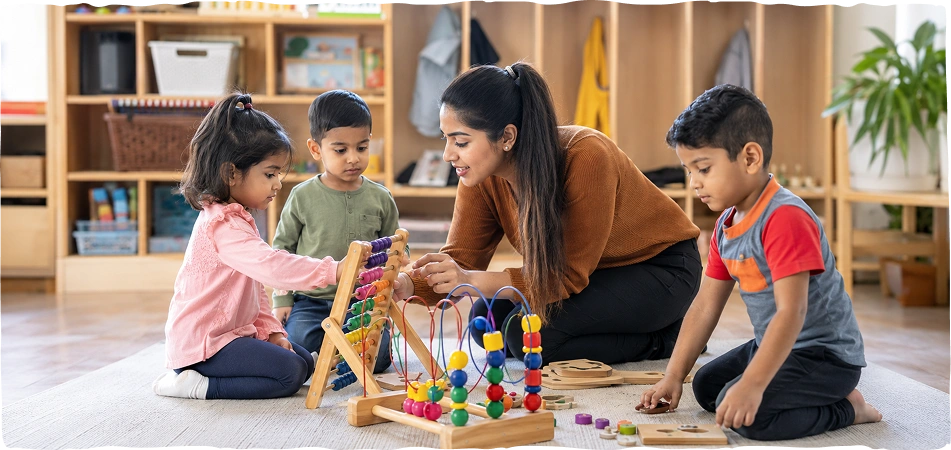
4. Mistakes Become Part of Learning
Independent learners need to understand that mistakes are not failures. Many Montessori materials are designed to provide children with opportunities to notice and correct errors themselves. When a child realizes that something does not work, they can pause, reconsider, and try again.
For example, if a child is arranging objects in a particular sequence and notices that the final pieces do not fit the expected pattern, they have an opportunity to examine their earlier choices.
The adult does not always need to say, “This is wrong.” Instead, the child can discover what needs to change. This develops self-correction, patience and resilience, all of which are essential qualities for lifelong learning.
5. Teachers Guide Rather Than Take Over
The Montessori teacher plays a highly purposeful role. Teachers observe children carefully, understand their developmental needs, and introduce materials at appropriate times. They demonstrate how an activity works and then allow the child to practice. This approach gives children space to develop competence.
Suppose a child is learning to pour water. An adult might be tempted to hold the container and help prevent every spill. In a Montessori environment, the child can be shown the process and given an opportunity to practice.
- There may be a little spillage.
- That is okay.
- The child learns how to control movement, respond to mistakes and try again.
The teacher remains nearby to support when necessary without taking away the child’s opportunity to learn.
Montessori Builds Confidence Alongside Independence
Independence and confidence often grow together. When children repeatedly experience, “I tried something, I worked through it, and I managed to do it,” their belief in their own abilities becomes stronger.
This can be seen in everyday situations. A child who once needed help putting on their shoes may eventually attempt it independently. A child who relied on an adult to choose an activity may begin making thoughtful choices. A child who became frustrated by difficult puzzles may start trying different approaches before asking for help.
These are not just practical achievements. They shape the child’s attitude towards challenges. Instead of thinking, “I cannot do this,” the child begins to think, “I can try.”
That mindset can influence how they approach reading, mathematics, creative activities, friendships, and new experiences as they grow.
The Six Areas of Development Work Together
At Bodhi Montessori, independence is not treated as a separate skill that children learn in isolation. Our Montessori programme supports multiple areas of development because children grow as whole individuals.
Fine motor activities can strengthen coordination and prepare children for writing. Sensory activities help children observe and distinguish differences. Practical-life activities develop self-care and responsibility. Social experiences teach children cooperation and respect.
Cognitive activities encourage reasoning and problem-solving. Emotional development helps children recognise feelings and manage everyday challenges.
For example, preparing a simple classroom activity may involve carrying materials, arranging them carefully, following a sequence, concentrating on the task and returning everything afterwards.
One activity can therefore support physical, cognitive, emotional and social development simultaneously.
Independence Does Not Mean Doing Everything Alone
This is one of the most important things parents should understand about Montessori education. Independent learning does not mean children should never ask for help.
In fact, knowing when to ask for help is itself an important part of independence. The goal is to help children attempt appropriate challenges before automatically depending on someone else.
Imagine a child struggling to open a container. Instead of immediately doing it for them, an adult might say, “Would you like to try another way?”
The child may try again. If they still cannot manage, the adult can provide appropriate support. This teaches children that asking for help is not a weakness. It is one of the tools they can use when solving a problem.
How Parents Can Encourage Montessori-Inspired Independence at Home
The Montessori philosophy does not have to stop at the school entrance. Parents can create simple opportunities for independence at home by giving children manageable responsibilities.
Let them choose between two suitable outfits. Encourage them to put their books away after reading. Allow them to help set the table. Give them time to attempt simple self-care routines. Involve them in tidying their play area.
The key is not perfection. If a child takes longer to complete a task, allowing that extra time can be more valuable than doing it quickly for them.
For example, if a child is learning to pour water, expect a few spills. If they are putting away toys, the process may not look perfectly organized. The purpose is to build capability through practice.
Why This Matters Beyond Preschool
The real value of independent learning becomes increasingly visible as children grow. It helps children develop habits and attitudes that support both academic success and everyday life.
- Builds decision-making skills: Children become comfortable making age-appropriate choices and taking responsibility for them.
- Strengthens concentration: Regular independent activities help children focus on tasks for longer periods.
- Encourages problem-solving: Children learn to explore different solutions instead of immediately waiting for an adult to help.
- Develops resilience: They begin to understand that mistakes are a natural part of learning, not a reason to give up.
- Creates a love for learning: Independent learners are more likely to approach unfamiliar tasks with curiosity and confidence.
- Promotes responsibility: Children learn to manage their materials, complete tasks and care for their surroundings.
- Builds confidence: Successfully completing tasks gives children the belief that they are capable of learning and improving.
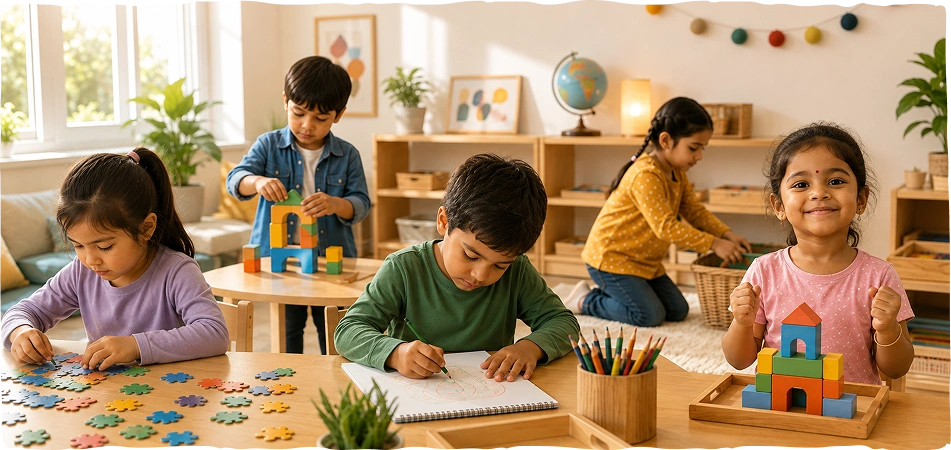
Conclusion
At Bodhi Montessori, we see every child as capable of growth when given the right environment, guidance, and opportunities.
Our Montessori approach combines the richness of Montessori methodology with values rooted in Indian culture, helping children develop as curious, compassionate and confident individuals. With a carefully prepared environment and a focus on self-directed, hands-on learning, children are encouraged to explore at their own pace while developing responsibility and respect for others.
For families looking for a nurturing environment where children can discover their abilities and gradually learn to do more for themselves, the journey begins with giving them the opportunity to try.
Admissions are open for 2026 at Bodhi Montessori. Discover a learning environment where curiosity is encouraged, independence is nurtured, and every child gets the space to thrive and grow. Enquire with us today and explore how our Montessori programme can support your child’s early years.
TABLE OF CONTENTS
SHARE THIS ARTICLE
Frequently Asked Questions

Montessori gives children opportunities to make choices, complete tasks, care for materials and solve age-appropriate problems with guidance rather than constant adult intervention.
Early independence helps children develop confidence, responsibility, concentration, decision-making and problem-solving skills that can support their academic and personal growth as they get older. This is one of the key reasons early education is so important in a child’s development.